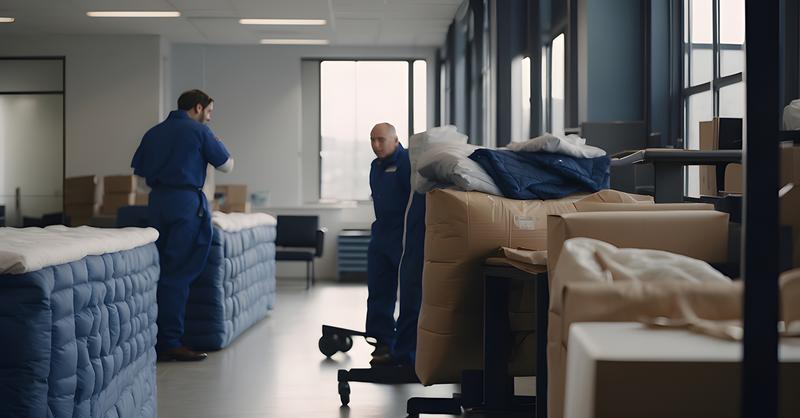
Your managing partner signed the new lease last Tuesday. The landlord at your current Hackensack suite wants you out by month’s end. You search “commercial office movers NJ,” fill out three web forms, and within an hour you’ve got quotes ranging from $2,800 to $11,000 for the same 30-person office. One of those numbers is a lie.
I know because we get the rescue calls. A facilities director in Paramus booked a company off a Google ad last spring. The quote came in at $3,200 over the phone. No walkthrough, no measuring tape, no mention of the building’s freight elevator reservation policy. Move day arrived, and the crew showed up two hours late in an unmarked rental truck. They wanted $1,400 extra for “long carry” from the elevator to the loading area. By 2 PM, half the cubicle panels were flat-stacked on the truck floor (which warps the frames and kills acoustical integrity), and the IT closet sat untouched because nobody brought static-shielding wrap.
She called us at 3:30 PM. We couldn’t take the job mid-disaster, and honestly that’s the part that sticks with me. We had to tell her to document everything, dispute the charges, and call back when she was ready to move properly into the new space. That conversation cost us nothing and saved her from paying ransom on mislabeled server racks.
The company she’d hired was a broker. They never owned a truck.
A broker sells your move to the lowest-bidding subcontractor. That sub hires day laborers. Those laborers have never seen your floor plan, don’t carry a Certificate of Insurance naming your landlord as additional insured, and couldn’t tell you the difference between a modular panel teardown and a demolition job. So how do you tell if you’re talking to a broker or an actual commercial moving company in New Jersey? Ask one question: “Will the person giving me this estimate also be on the truck?” If the answer is anything other than a direct yes, you’re talking to a sales desk.
Pack and Care Moving and Storage operates as the carrier, the crew, and the insurance holder. We dispatch the same foreman who walks your Bergen County office with a measuring wheel to lead the move. Our technicians are W2 employees, background-checked, uniformed, and averaging seven years on commercial relocation jobs across the NJ, NY, CT, PA, MD, and MA corridor. When your building management calls to verify our COI, they reach our insurance carrier directly. Not a broker’s answering service.
| Factor | National Brokerage Model | Pack and Care Protocol |
|---|---|---|
| Quote method | Phone estimate, no walkthrough | On-site walkthrough with the actual crew foreman |
| Final price vs. estimate | 40-60% above original number | Binding not-to-exceed contract, line-item transparent |
| COI issuance | Cannot issue from own policy | Same-day COI off our $5 million umbrella coverage |
| Crew accountability | Unknown subcontracted labor | In-house W2 technicians, GPS-tracked truck, foreman cell number from day one |
| Post-move support | Disconnected phone number | Single point of contact through final chair placement and IT reconnect |
Moving a 40-person law firm out of a Fort Lee high-rise isn’t just about boxes. It’s a logistics sequence with hard deadlines imposed by the building, the municipality, and the geography itself.
We operate out of 415 14th St, Carlstadt, NJ 07072, which puts us minutes from the Route 17 South corridor and gives our dispatch team direct knowledge of the commercial bottleneck between Ridgewood Avenue and the Route 4 interchange. We don’t guess at arrival times. We route around them.
One thing most office managers don’t anticipate: after-hours noise ordinances. Can commercial movers in NJ operate overnight for a server relocation? In most Bergen County municipalities, yes, but you need prior coordination with building management and sometimes a noise variance from the township. We handle that filing as part of our move coordination so your IT disconnect/reconnect runs from 6 PM to 6 AM without a knock from local police at midnight.
That’s not a tagline. It’s the operational sequence we execute for corporate workplace migrations across Bergen County.
The timeline looks like this for a typical 50-person professional services firm:
We ran this exact sequence for an accounting firm relocating from Hasbrouck Heights to Rochelle Park last fall. Forty-two workstations, a server closet, and a glass-walled conference room with millwork that the previous mover (a broker sub, naturally) had refused to touch. The only hiccup was a freight elevator that ran slower than the building super had promised, which cost us about 40 minutes. We absorbed it. The client’s staff never knew.
A server rack wheeled across a threshold without a vibration check can send a disk array into failure. That’s not theoretical. I’ve seen the help desk tickets.
What does full service commercial moving include for IT equipment in New Jersey? Our protocol covers static-shielding wrap on every piece of hardware, color-coded port labeling by employee so the reconnect takes minutes instead of hours, server rack palletization with anti-vibration padding, and whip checks on all cabling before transport. We coordinate with your IT director or MSP so the reconnect sequence mirrors the disconnect. No guesswork, no “which cable goes where” panic at 7 AM.
The difference between our approach and the broker method is physical. Brokers’ subcontracted crews wrap servers in standard moving blankets. Moving blankets generate static. Static kills components. (And if you think the broker’s “insurance” covers data loss from electrostatic discharge, go ahead and read that policy’s exclusions. I’ll wait.) We carry dedicated anti-static wrap, ground straps, and climate-controlled transport options for sensitive equipment, including gap-move storage at our secure warehouse when your lease dates don’t perfectly align.
If your office runs on-premise servers and you’re planning a relocation with binding estimates, the IT protocol should be the first conversation, not an afterthought tacked onto a box-moving quote.
Gap moves. Every Bergen County office manager dreads them.
We maintain climate-controlled commercial storage for exactly this scenario. Your FF&E (furniture, fixtures, and equipment) goes into our secure facility with 24/7 code access and a digital inventory your facilities director can check from their phone. Cubicle panels stay in upright racks. File cabinets stay shrink-wrapped and locked. Server equipment stays on anti-vibration pallets in a temperature-stable zone.
Short-term or long-term, the storage rate is locked into your moving contract. No monthly surprise increases. No “retrieval fees” when you’re ready for delivery to the new office. How long does it take to move a 20 person office out of storage and into a new suite? If we packed and inventoried it on the way in, reinstallation typically runs a single business day. The labeling system we applied during the original move carries through, so reassembly in the new space follows the same floor plan sequence without re-sorting.
Our binding not-to-exceed contract lists every cost you’ll pay. Labor hours. Truck dispatch. Cubicle disassembly and reassembly. Floor protection for marble lobbies (a non-negotiable in most Mack-Cali managed buildings). COI filing. Packing materials. Municipal permit fees if Paramus or any other township requires one for your specific street.
No stair surcharges. No elevator fees. No “long carry” add-ons because the loading dock happens to be 80 feet from the freight elevator. No fuel surcharge buried in page four of the fine print.
Your walkthrough is free and carries zero obligation. We send the foreman who will run the job. He measures doorways, elevator cab dimensions, and stairwell turns. He maps the floor-to-truck path. You receive a fixed price within 48 hours that will not change on move day. If our final invoice somehow exceeds that binding number, we credit you $500. That promise is tied to our USDOT registration, not a marketing landing page.
(I realize that sounds like every moving company’s pitch. The difference is we put it in the contract with a financial penalty against ourselves. Ask your broker to do that.)
Most Paramus and Mahwah commercial leases flip at month’s end. NJ DOT work on Route 17N between Ridgewood and Paramus creates unpredictable delays every construction season. February nor’easters force contingency planning for weather-sensitive server moves. The George Washington Bridge approach backs up crew arrival windows by 45 minutes during peak commuter hours if your new office sits in Fort Lee or Edgewater.
We build all of this into your move plan before you sign. Arrival windows are confirmed based on actual traffic modeling from our Carlstadt dispatch, not a generic “between 8 and 12” window that means nothing. Your foreman texts you at truck dispatch. GPS tracking gives you a live ETA.
Do office movers need a COI in New Jersey, and who files it? Any reputable commercial mover must carry workers’ compensation, commercial general liability, and cargo coverage. Bergen County building managers almost universally require a COI naming them as additional insured before granting dock or elevator access. We file it same-day from our $5 million umbrella policy. If a mover tells you they’ll “get to the COI later,” they’re either a broker who can’t issue one or they’re planning to skip it and gamble on not getting caught at the loading dock.
Your move costs what we say it costs. Your downtime stays at zero. That’s how we’ve built this business, and it’s the only honest way to relocate an office in Bergen County.
Ready to lock your crew and dock slot? Call us at (862) 459-0082. Follow our commercial moving updates on LinkedIn and Instagram.
Written by: Carlos Espinoza
Pack and Care Moving and Storage