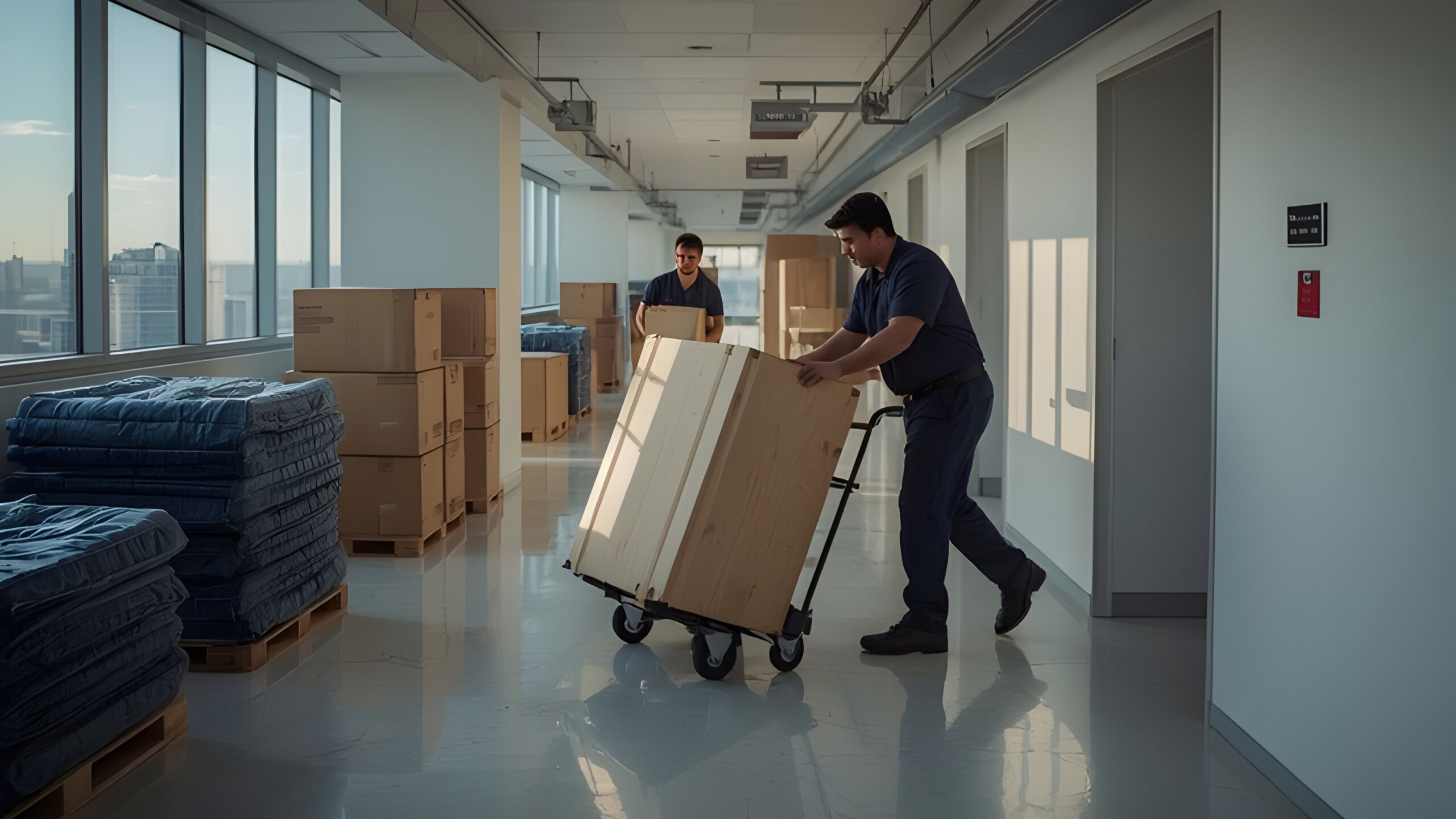
Climate-controlled residential transit storage NJ means your household goods are sealed inside individually locked modular wooden vaults, held between 60°F and 75°F with relative humidity kept at 45% to 55%, while your move sits in the gap between origin and delivery.
That’s the whole definition. No fluff, no marketing spin.
I’ve been running Pack and Care Moving and Storage out of Carlstadt for years, and I still hear the same story from Bergen County homeowners: they thought “climate-controlled” meant something specific until a broker parked their furniture on an open pallet inside a Meadowlands warehouse with the loading bay door propped open in August.
Here’s what genuine transit storage looks like in practice:
If a provider can’t cite the temperature range, humidity band, or show you the seal protocol, the phrase is basically decoration.
Closings slip. That’s the Bergen County housing market in one sentence.
You’re upgrading from an Edgewater condo to a colonial in Tenafly, and the seller’s title work drags. Or the buyer on your Ridgewood place needs a two-week extension. Suddenly you have furniture that needs to sit somewhere for 30, 60, sometimes 90 days.
The question isn’t whether you’ll need storage. It’s whether the storage you get will protect your stuff or quietly damage it while you’re distracted with mortgage paperwork.
If you’re moving out of a Fort Lee or Cliffside Park high-rise, your building’s board wants a Certificate of Insurance naming the condo association as additional insured. Freight elevator windows book weeks out. Miss the reservation and you’re rescheduling with a truck sitting on River Road racking up hours.
My crews handle the COI directly. We issue it in about 48 hours and send it to building management before the truck rolls. (I’ve watched brokered carriers show up without one and get turned away at the loading dock. Real thing that happens.)
What actually goes wrong when the storage facility is a subcontracted warehouse? Your chain of custody breaks at the dock door. If an armoire comes out with a water ring, the broker, the carrier, and the warehouse each point at the other two. You spend three months chasing a claim nobody wants to pay.
People ask what makes a wooden vault different from a regular storage unit. Fair question.
A standard self-storage locker is a concrete box with a rolldown door. Air moves freely, dust settles, and in a New Jersey summer, humidity inside can push past 70%. Wood veneers lift. Leather sofas grow mildew spots you don’t see until delivery day.
Our modular wooden vaults are built to a different logic:
The point isn’t the wood. It’s the containment. Once your vault is sealed, dust and pests can’t drift in. Nothing shifts. Nobody’s poking around your inventory because there’s nothing to poke at.
A few summers back we moved a family out of a pre-war place on Union Street. Beautiful old walnut dining set, the kind you inherit and don’t replace. Their closing on a Franklin Lakes house pushed 47 days.
They’d almost gone with a national broker who quoted them 20% less. That broker’s “climate-controlled” facility, I later found out from a neighbor, was a partitioned corner of an unregulated warehouse near the Turnpike. The neighbor’s piano came out of that same place with a cracked soundboard. Humidity swings, plain and simple.
Our vault held the walnut set at consistent humidity for six and a half weeks. No swelling, no lifting, no drama. (Look, I’m not saying every non-climate storage ruins furniture. I’m saying you don’t roll the dice on inherited walnut when the fix is a proper vault.)
Here’s the pattern I’ve watched play out too many times.
You call a number from a Google ad. A friendly voice quotes you $2,400 for a move plus storage. You book. On move day, a truck shows up with a crew you’ve never heard of, wearing no company shirts, driving a rental. They load your stuff.
Then the real invoice appears: fuel surcharge, stair fee, long-carry fee, storage access fee, shrink-wrap fee. Suddenly you’re at $5,800. Your furniture is on the truck. What are you going to do, unload it in the driveway?
That’s the hostage load. It works because the broker never had control of your move to begin with. They auctioned you.
How do you tell the difference between a legitimate mover and a broker before you sign anything? Ask who owns the trucks, whether the crew is W-2, and where the storage facility is physically located. If the answer involves “our carrier partner” or “we work with a network,” you’re talking to a broker.
Our estimates break out every cost before we load anything:
The price you approve is the price at delivery. If your closing slips, you extend month to month at the same rate. No renegotiation. Check out our transparent pricing breakdown if you want the full mechanics.
Local roadway reality shapes every Bergen County move we run.
Route 17 through Paramus and Hasbrouck Heights gets brutal by 10 AM on Saturdays. Route 4 near the Bridge approach clogs anytime the Meadowlands has an event. If your out-of-state broker doesn’t factor this in, you’re paying for a truck stuck in traffic while your elevator window expires.
My dispatch sets Bergen County move-outs to start early (usually 8 AM) so we’re loading during the quiet window. For Edgewater and Fort Lee jobs, we coordinate freight elevator times based on which buildings enforce 9 AM to noon Saturday cutoffs. Local knowledge, nothing fancy.
What’s the smartest window to schedule a move-out from an Edgewater high-rise? Weekday mornings between 8 and 11 AM, before the school run empties and after the overnight commercial ban lifts. Weekend elevator slots book two to three weeks out and end-of-month weekends are essentially unavailable.
End-of-month is when everything compresses. Leases expire, closings fund, and half the county wants a truck. If you’re facing a July or August lease-end in Fort Lee, book your transit storage vault at least three weeks out. Elevator reservations, street permits, COI issuance, none of that happens overnight.
New Jersey summers push warehouse interiors past 90°F with humidity in the 65% to 75% range. Winter brings the opposite: dry cold and condensation cycles near loading bays where salt residue drifts in on tires.
Both extremes wreck household goods:
Holding 60°F to 75°F with 45% to 55% humidity means none of that happens. It’s mechanical HVAC, dehumidification, and monitoring logs that get checked daily.
Do I really need climate control for a 30-day transit gap, or am I being oversold? If you own anything wood, leather, or electronic, yes. Thirty days in a Jersey July inside an unregulated warehouse is enough to warp a piano lid or fog a flat-screen. If you’re storing metal patio furniture and plastic bins, probably not.
Our process is boring on purpose. Boring means predictable, and predictable is what you want during a relocation.
We operate out of 415 14th St, Carlstadt, NJ 07072, which puts our trucks fifteen minutes from most Bergen County origins and connected directly to the Turnpike for cross-country runs.
Can I access items in my vault mid-storage without an extra fee? Yes, with 48 hours notice for scheduling. We don’t charge storage access penalties, which is one of those hidden fees brokers love to bury in the fine print.
| Service Element | National Broker | Pack and Care |
|---|---|---|
| Initial Quote | Lowball estimate, verbal | Fixed line-item, written |
| Day-of Fees | Fuel, stairs, long-carry surcharges | None. Quote is the price. |
| Storage Access | Access fees per visit | Included with 48-hr notice |
| Crew | Subcontracted day labor | W-2, background-checked, uniformed |
| Storage Facility | Unknown third party | Directly managed, Carlstadt |
| Closing Delay | Renegotiated contract | Month-to-month, same rate |
If you’re planning a move that involves any gap between origin and destination, ask the hard questions before you sign. Get the temperature range in writing. Get the humidity band. Ask who owns the storage facility and whether the crew delivering your goods is the same crew that loaded them.
If the answers get vague, walk. A cheap quote from an untraceable broker is the most expensive mistake you can make with your household goods.
I’ve built this business on the opposite premise. If telling you the truth about what real climate-controlled transit storage costs makes you shop around, so be it. I’d rather lose a booking than sell you a service that damages furniture you can’t replace.
You can find us on LinkedIn and Instagram if you want to see our crews in action, or just call us at (862) 459-0082 when you’re ready for a real quote. We also handle long-distance moves across the 48 states when your relocation extends beyond the Tri-State corridor.
Keep your closing loose. Keep your furniture safe. Skip the broker.
Written by: Carlos Espinoza
Pack and Care Moving and Storage